 English
 عربى
عربى
 中文繁体
中文繁体

Content
Quick Answer: What to Prioritize When Buying
The right brake pad press machine comes down to matching tonnage to your pad size and formulation density (typically 100-800 tons for most commercial operations), choosing an automation level that fits your labor budget and output targets, and confirming the machine's cycle time can meet your daily production goals. Undersized tonnage is the most common and costly mistake — it leads to incomplete compaction, weak pads, and higher scrap rates that are far more expensive than the price difference between machine tiers.
As a general guideline: small workshops producing under 5,000 pads per day typically need 100-300 ton semi-automatic presses, while high-volume manufacturers producing 20,000+ pads daily generally require 400-800 ton fully automatic multi-station presses.
Understanding Tonnage Requirements
Tonnage determines whether your press can generate enough compression force to properly bond friction material to the backing plate, and it directly affects pad density and structural integrity.
How Tonnage Is Calculated
Required tonnage is generally estimated using the pad's surface area multiplied by a pressure factor specific to the friction material formulation, typically ranging from 3,000 to 6,000 PSI depending on the resin and filler composition. Larger pads, such as those used for trucks and commercial vehicles, require proportionally more tonnage than passenger car pads of the same material.
Tonnage by Application
| Application | Typical Pad Size | Recommended Tonnage |
|---|---|---|
| Motorcycle pads | Small (under 50 cm²) | 60-120 tons |
| Passenger car pads | Medium (50-100 cm²) | 150-350 tons |
| Light truck/SUV pads | Large (100-150 cm²) | 350-500 tons |
| Heavy commercial pads | Extra large (150+ cm²) | 500-800 tons |
Buying a press with 10-20% more tonnage than your current maximum requirement is a common industry practice, since it provides headroom for producing larger pad formats in the future without needing to replace the entire machine.
Automation Levels: Manual, Semi-Automatic, and Fully Automatic
Automation level affects labor cost, consistency, and total output far more than most buyers initially expect.
Manual Presses
Manual presses require an operator to load material, initiate the press cycle, and unload each pad individually. These are the lowest-cost option but also have the lowest throughput and the highest variability in pad quality due to operator inconsistency.
Semi-Automatic Presses
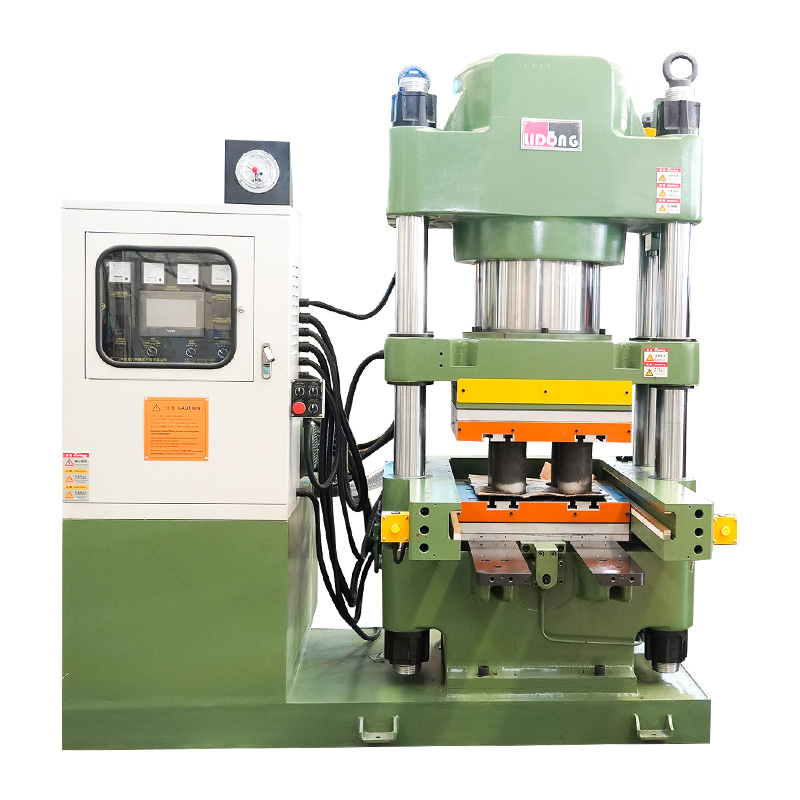
Semi-automatic presses automate the compression and heating cycle but still require manual loading and unloading. This tier offers a meaningful jump in consistency and output while keeping capital costs moderate, making it the most common choice for small-to-mid-size manufacturers.
Fully Automatic Presses
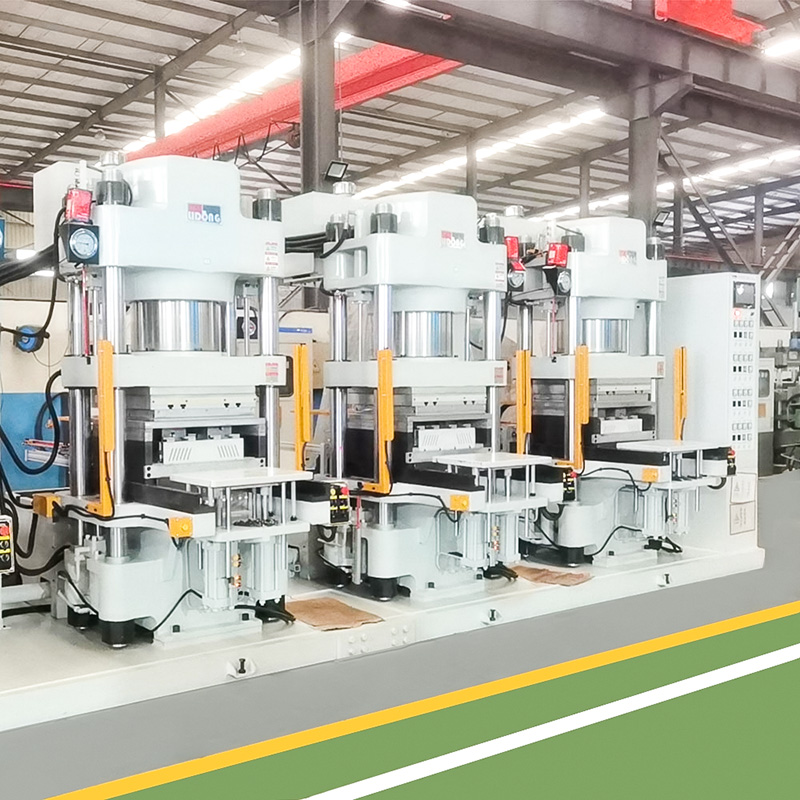
Fully automatic multi-station presses handle loading, pressing, curing, and unloading with minimal operator intervention. These systems can run continuously across multiple molds simultaneously, dramatically increasing daily output, but require a significantly higher upfront investment and more technical maintenance expertise.
Output and Cycle Time Benchmarks
Cycle time — the total time from loading material to ejecting a finished pad — is the key figure for calculating realistic daily output.
- Manual presses: cycle times of 3-5 minutes per pad, yielding roughly 100-200 pads per 8-hour shift
- Semi-automatic presses: cycle times of 1.5-3 minutes per pad, yielding roughly 200-400 pads per shift
- Fully automatic multi-station presses: cycle times as low as 30-60 seconds per cavity across multiple simultaneous molds, yielding 1,000+ pads per shift depending on station count
A fully automatic press with 8-12 mold cavities can realistically outproduce three or four semi-automatic machines combined, which is why many mid-size manufacturers eventually consolidate onto fewer, higher-capacity automated lines rather than continuing to scale with additional semi-automatic units.
Additional Specs to Evaluate
Beyond tonnage and automation, several other specifications significantly affect real-world performance and long-term cost.
- Heating system type: electric heating plates offer more precise temperature control than older oil or steam-heated systems.
- Temperature range and uniformity: quality presses typically maintain plate temperatures between 150-200°C with variance under ±3°C across the mold surface.
- Mold cavity count: more cavities per cycle directly increase output without requiring a proportional tonnage increase, provided total clamping force is sufficient.
- Control system: PLC-based controls with programmable pressure/time/temperature profiles reduce human error and improve batch-to-batch consistency.
- Safety features: light curtains, two-hand operation controls, and emergency stop systems are standard requirements in most regions' industrial safety codes.
Temperature uniformity across the mold surface has a direct impact on pad quality, since uneven curing can create weak points in the friction material that lead to premature pad failure or noise complaints once installed on a vehicle.
Cost and ROI Considerations
Machine price varies enormously based on tonnage and automation level, so it's worth thinking in terms of cost per unit produced rather than sticker price alone.
- Manual presses (100-200 tons): typically $8,000-$25,000
- Semi-automatic presses (150-400 tons): typically $25,000-$80,000
- Fully automatic multi-station presses (400-800 tons): typically $80,000-$300,000+
While fully automatic systems carry a much higher upfront cost, the lower per-unit labor cost often allows manufacturers to recover the price difference within 12-24 months at moderate-to-high production volumes, making the total cost of ownership a more useful comparison metric than the initial purchase price alone.
Quick Buying Checklist
Before finalizing a purchase, confirm the following:
- Have you calculated tonnage based on your largest planned pad size, with headroom for future formats?
- Does the automation level match your labor budget and daily output targets?
- Can the cycle time realistically meet your production quota within your operating hours?
- Does the heating system offer sufficient temperature uniformity for your friction material formulation?
- Does the machine meet the safety certification requirements for your region (CE, OSHA, or local equivalents)?
Getting these specifications right from the start avoids the two most common and costly mistakes in this equipment category: undersized tonnage that compromises pad quality, and automation mismatches that either waste capital or bottleneck production.